Network Usage Fee Dispute as a Cost Attribution Problem
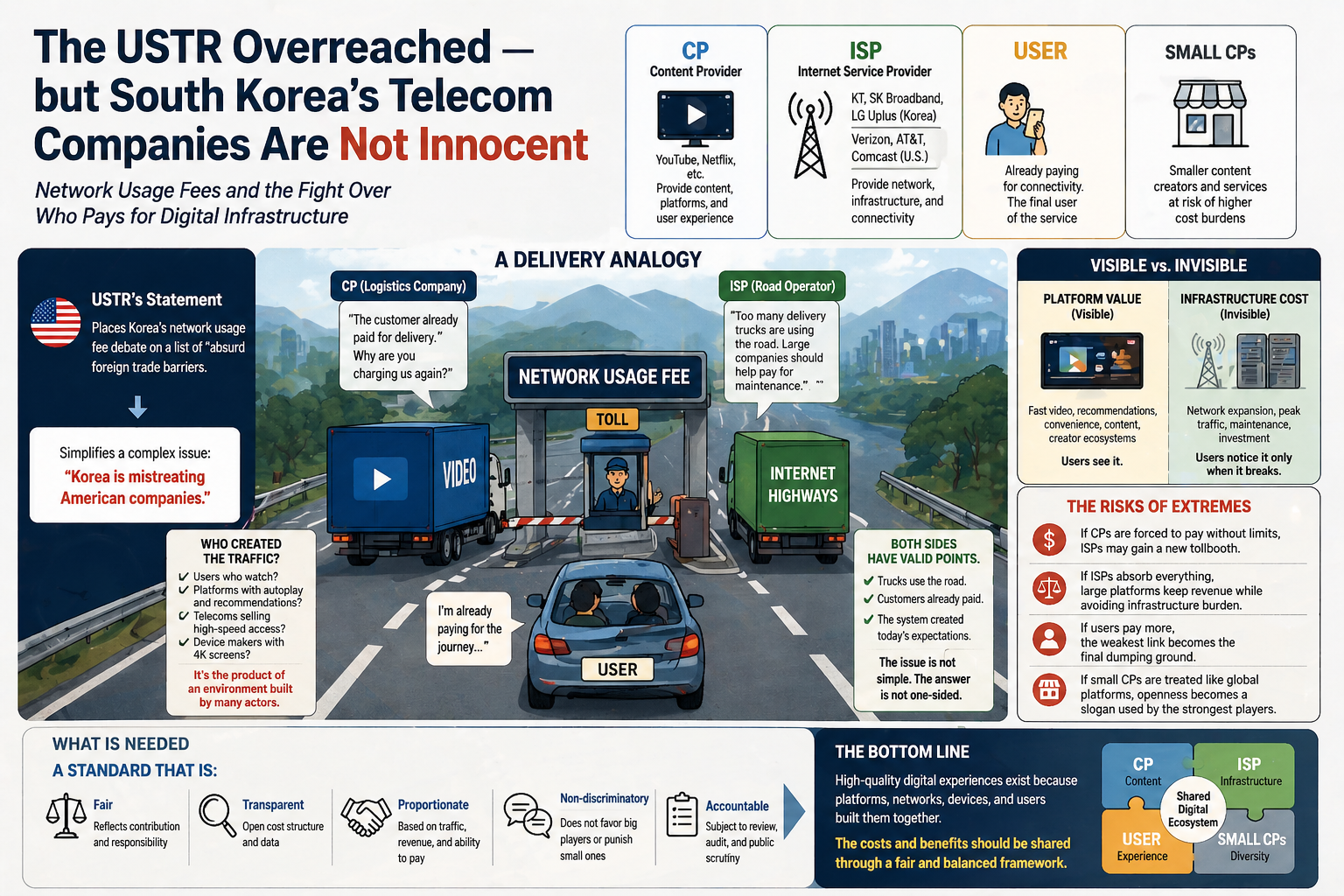
One-line claim
Network usage fee disputes should not begin with “who pays?” but with “who structured the high-bandwidth digital environment that made the cost arise?”
Why this case matters
The USTR framed South Korea’s network usage fee debate as an absurd foreign trade barrier. That framing matters because it turns a domestic infrastructure cost-allocation dispute into a trade-barrier narrative.
The case is useful because it shows how platform value, network cost, user exposure, and trade pressure become entangled.
Actor map
| Actor | Role | Public claim | Main risk |
|---|---|---|---|
| Large CPs | High-bandwidth service designers | Internet openness / double charging | Cost avoidance |
| ISPs | Network operators | Network investment sustainability | Rent extraction |
| Users | Final consumers | Already paying | Final cost absorption |
| Smaller CPs | Low-buffer entrants | Market access | Entry barriers |
| Government | Rule-setter | Balance and regulation | Policy-space pressure |
| USTR / trade power | Upper-level framing actor | Trade barrier framing | Responsibility relocation |
Diagnostic standard
A fair cost-attribution standard should consider:
- contribution to cost generation
- revenue gained from the cost-generating environment
- ability to shape the environment
- absorptive capacity
- system sustainability
- risk of passing costs downward
- risk of reframing responsibility through trade pressure
Core conclusion
Large CPs and ISPs should absorb the primary burden, but only under rules that prevent:
- pass-through to users
- exclusion of smaller CPs
- ISP rent extraction
- degradation of open internet conditions
- trade-pressure reframing that prevents domestic cost-allocation debate