Current Work
Research on work, labour-market institutions, technological change, and how risks, resources, and opportunities are distributed across workers, households, and organizations.
This page is a first-meeting view of work that is moving now. It is selective rather than exhaustive: each item points to a live research question, its current stage, and where collaboration could be useful.
Seeing the Wealth Surface Where did Korea's age × income-position wealth surface rise between 2017 and 2025?
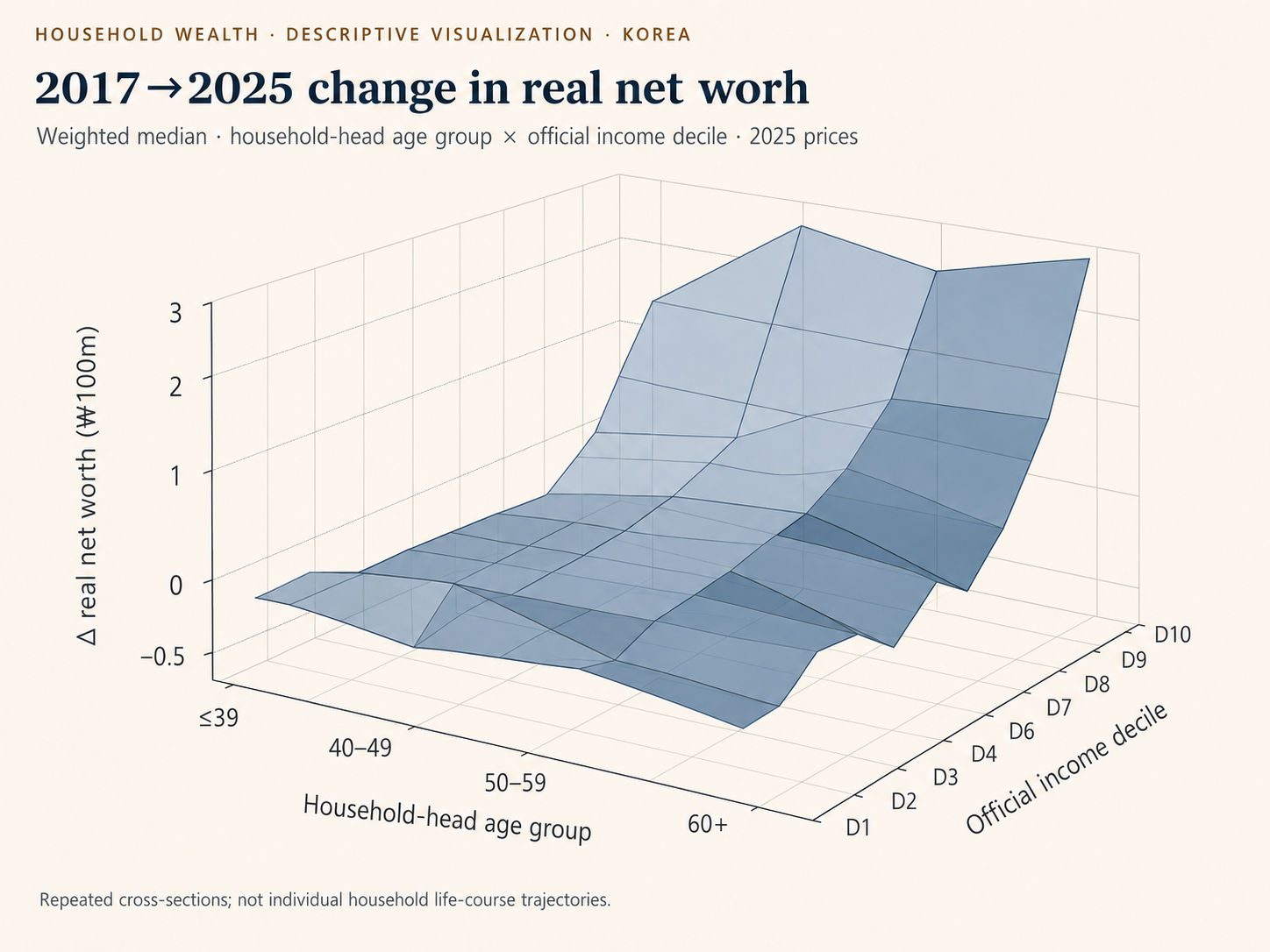
This descriptive research note places household-head age group, official income decile, and real net worth on a fixed grid so that changes in the shape of the wealth surface can be seen directly over time. It does not propose a new inequality index or causal model.
Current finding: the 2017–2025 change is not evenly distributed across the surface. The largest weighted-median increases are concentrated around the upper-income ridge, especially D10.
Current stage: short descriptive / visualization note using Korea's Household Finance and Welfare Survey, 2017–2025; level surfaces, repeated time deformation, and 2017–2025 delta surfaces are complete.
Interpretive caution: repeated cross-sections; the surface deformation should not be read as the life-course trajectory of the same households.
Collaboration: household wealth inequality, descriptive distribution analysis, visualization, age–income structure.
Featured research
Labour Persistence–Time Absorption (LPTA) When technology saves workers time, who gets that time?
LPTA examines why productivity gains can reduce task-time without reducing working time. In time-based employment, saved task-time may reappear as denser workloads, task expansion, higher performance baselines, or intensified monitoring rather than reduced hours or recovery.
Current stage: ILERA Asia 2026 conference paper linking the mechanism to demographic ageing and unequal dependence on labour income.
Collaboration: working-time institutions, ageing labour markets, collective bargaining, productivity sharing, performance measurement.
Japan–Korea Labour Retention & Worker Option Architecture What turns staying, leaving, or continued employment into a particular worker trajectory?
This ongoing comparative extension examines how workers' effective options are translated into employment outcomes. Existing Japanese and Korean surveys already capture exit intentions, constrained non-exit, retirement preferences, institutional gates, consultation, and employer-side HR practices in considerable detail. The remaining question is narrower: how a worker's concrete option or claim connects to an employer response, an actual workplace adjustment, and subsequent stay, exit, or continued employment.
Current stage: preliminary Japan–Korea survey-architecture audit; identifying what can already be recovered from existing microdata before proposing additional measurement.
Collaboration: later-life employment, worker voice, internal labour markets, HRM, longitudinal surveys, Japan–Korea comparison.
Labour-Income Sufficiency Coverage (LISC) / SEHRR Is labour income actually enough to sustain a household?
This line separates labour-market income sufficiency from household total-resource adequacy and asks how far earnings actually cover selected living or household-reproduction requirements.
Current stage: a Korea–UK–US portability pilot for LISC is closed; current work is moving toward literature positioning, benchmark comparability, decomposition, and links to household-level sufficiency analysis.
Collaboration: living wages, income adequacy, household reproduction, in-work insufficiency, comparative labour-market data, social protection.
Work Decomposition & Human Asset Reclassification How AI reshapes tasks, skills, and worker value.
This research maps how task bundles loosen and recombine as codification and coordination costs change, and how new task architectures can reprice workers' existing skill bundles. The question is not only whether a worker is more or less skilled, but how convertible existing capabilities are into the newly required bundle.
Current stage: synthesis map linking task architecture, re-embedding of tacit skill, worker repricing, organizational restructuring, and the LPTA time-allocation problem.
Collaboration: AI and work, occupational change, retraining, internal labour markets, skill transfer, organizational design.
Attribution Political Economy Who gets the performance — and who carries the risk?
This research separates the aggregation of distributed contributions from the later attribution of benefits, costs, risks, and responsibility. It examines how organizational performance can consolidate many small contributions while responsibility and adjustment costs remain distributed elsewhere.
Current stage: active conceptual architecture spanning performance attribution, risk attribution, gate structures, and organizational responsibility unbundling.
Collaboration: compensation systems, labour process, organizational performance, HR systems, risk allocation, worker contribution.
From Training to First Credibility Who validates a new worker when polished output becomes cheap?
This project examines the credibility bottleneck facing people without established work histories and asks how public employment services might govern expert review without creating purchasable endorsement or one-sided candidate transparency.
Current stage: collaborative-governance design using cross-national institutional sequence mapping across training, capability evidence, credibility formation, employer verification, and selection.
Collaboration: recruitment, labour-market entry, skills signalling, early careers, credentialing, public employment services, AI-assisted work.
Also exploring
Local Food Choice-Set Dynamics (LFCS) How might household purchasing capacity and small-business turnover reshape everyday local choice?
LFCS distinguishes store counts from the consumer-facing set of choices actually available in a neighbourhood. A high-context pilot in Banghwa 3-dong, Seoul reconstructed longitudinal choice sets, business lifecycles, same-site replacement, and spatial sensitivity; the descriptive and audit layer is closed, while post-pilot mechanism work and comparative expansion remain open.
Collaboration: disposable income, household demand, self-employment, local service economies, business turnover, neighbourhood change.
Selected writing
These shorter public pieces show how the same questions are applied to live labour and policy problems.
Cash Is Not the Only Language of Surplus
How productivity and surplus can be translated into time, recovery, security, or bargaining claims rather than cash alone.
Read →Performance Attribution Symmetry
A compact argument for applying the same attribution logic to gains and losses instead of individualizing failure while collectivizing success.
Read →Capital Played Global. Labor Reads Global Too.
Why global comparison is not only a managerial or investor privilege when firms already benchmark labour and performance internationally.
Read →Yellow Envelope Act: Early Procedural Risk
An early-stage procedural reading of uncertainty, responsibility, and implementation risk around labour-law change.
Read →Other work
My broader research also covers AI governance, institutional responsibility and repair, platform visibility, diagnostic protocols, political communication, and knowledge-production systems.
Ideas & Frameworks
Reusable concepts and analytical architectures.
Diagnostic Work
Protocols, audits, and applied review formats.
Essays & Papers
Longer public arguments and venue-shaped outputs.
Public Record
Accepted work, current status, public identifiers, and record files.
Work with me
I am especially interested in conversations where another dataset, country case, institutional setting, or disciplinary lens could test, extend, or challenge one of these structures.